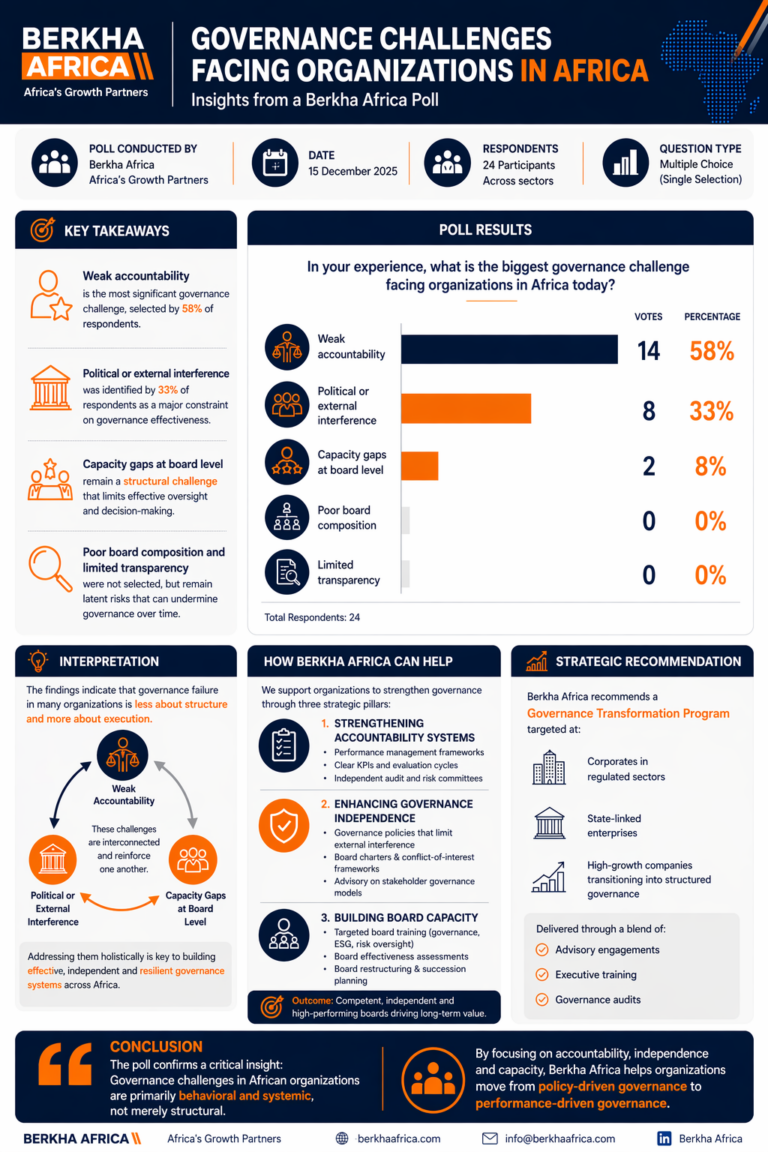
Governance remains one of the most critical determinants of organizational success across Africa. Yet, despite the presence of policies, structures, and regulatory frameworks, many organizations continue to struggle with execution. A recent poll conducted by Berkha Africa provides a focused snapshot of where the real challenges lie and what leaders must prioritize moving forward.
What the Data Reveals
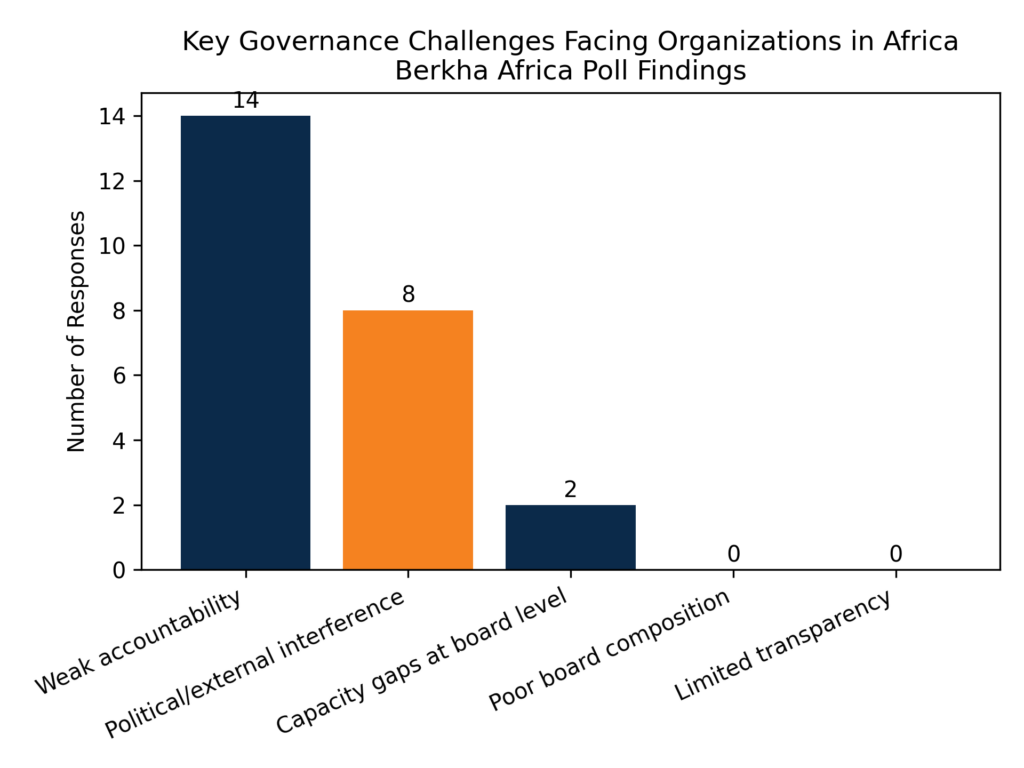
The poll highlights three primary governance challenges:
- Weak accountability (58%)
- Political or external interference (33%)
- Capacity gaps at board level (8%)
Interestingly, issues such as poor board composition and limited transparency recorded no votes. However, this does not imply their absence. Rather, it suggests that respondents perceive governance failures more through outcomes than through structural deficiencies.
Beyond Structures: The Execution Gap
Many organizations have governance frameworks in place. Boards are constituted. Policies are documented. Reporting lines are defined.
Yet, the challenge lies in enforcement.
Weak accountability points to:
- Limited consequences for underperformance
- Ineffective monitoring systems
- Blurred lines of responsibility
Similarly, political or external interference undermines:
- Board independence
- Strategic decision making
- Long term organizational stability
Capacity gaps at the board level further compound these issues, reducing the board’s ability to provide meaningful oversight and direction.
Why This Matters for African Organizations
In rapidly evolving markets, governance is no longer a compliance exercise. It is a strategic asset.
Organizations that fail to address governance risks face:
- Reduced investor confidence
- Operational inefficiencies
- Reputational damage
- Regulatory exposure
On the other hand, organizations that strengthen governance gain:
- Increased trust from stakeholders
- Better decision making
- Sustainable growth
How Berkha Africa Supports Governance Transformation
At Berkha Africa, governance is approached as a system, not a checklist. The focus is on embedding accountability, strengthening independence, and building capacity.
1. Strengthening Accountability Systems
We design and implement performance frameworks that ensure:
- Clear KPIs for leadership and boards
- Regular performance evaluations
- Transparent reporting mechanisms
2. Enhancing Governance Independence
We support organizations to:
- Establish strong board charters
- Implement conflict of interest policies
- Protect decision-making from undue influence
3. Building Board Capacity
We equip boards with the skills and structure required to lead effectively through:
- Targeted training programs
- Board effectiveness assessments
- Governance audits and restructuring
- The poll confirms a critical insight:
Governance challenges in African organizations are primarily behavioral and systemic, not merely structural. - By focusing on accountability, independence, and capacity, Berkha Africa is well-positioned to help organizations move from policy-driven governance to performance-driven governance.